

|
|
Support
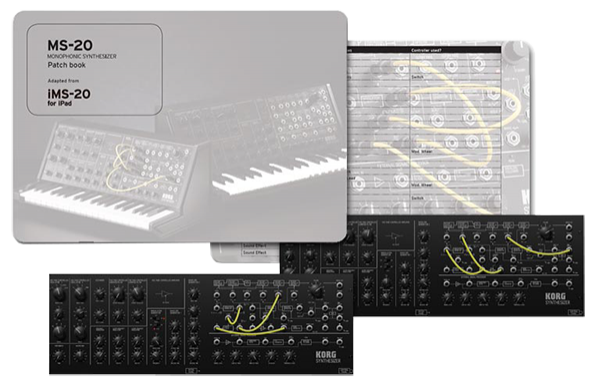
5/8/13 - MS-20 Setting ExamplesALL:USA_ms20_setting_ej_2012.pdf This booklet (in PDF format) shows you how to get a variety of specific sounds with the MS-20. You can use these settings as they are, and as a base for discovering new effects. 5/8/13 - MS-20 Mini Owner's ManualALL:USA_MS20mini_OM_EFG_1.pdf This is the MS-20 Mini Owner's Manual. Please use this in conjunction with the MS-20 Owner's Manual.
MS-20 mini
Monophonic Analog Synthesizer
The classic MS-20 –recreated in mini size!
An analog synthesizer featuring the original circuitry from 1978
Korg’s MS-20 monophonic synthesizer, first introduced in 1978, is still a coveted instrument to this day, thanks to its thick, robust sound, its powerful, iconic analog filter, and its versatile patching options. Over 300,000 people have enjoyed the distinct MS-20 sounds from the original, from Korg’s MS-20 plug-in synth, or the iMS-20 iPad app.
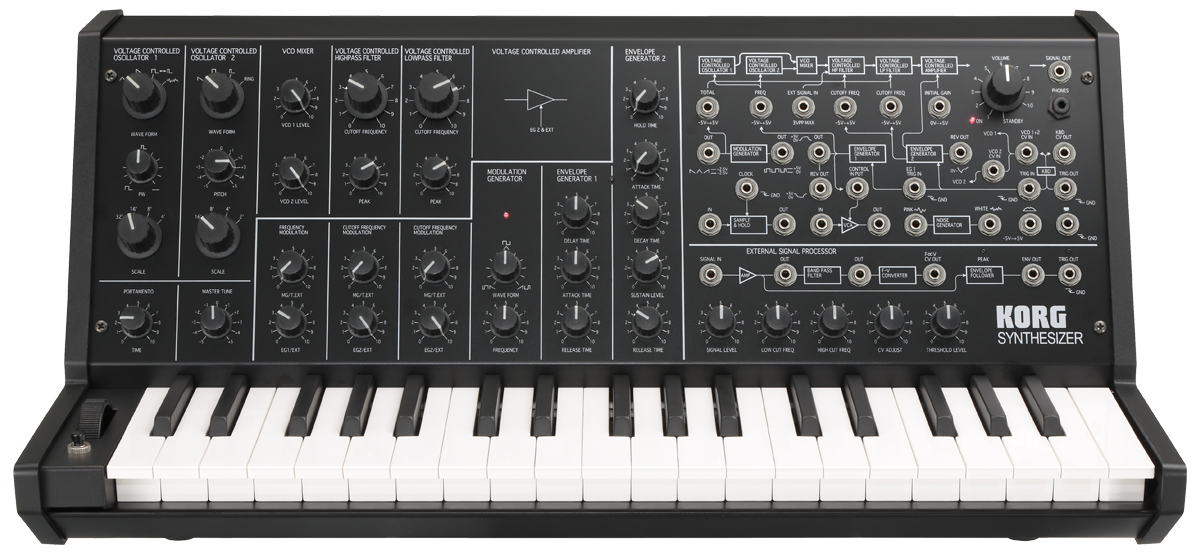
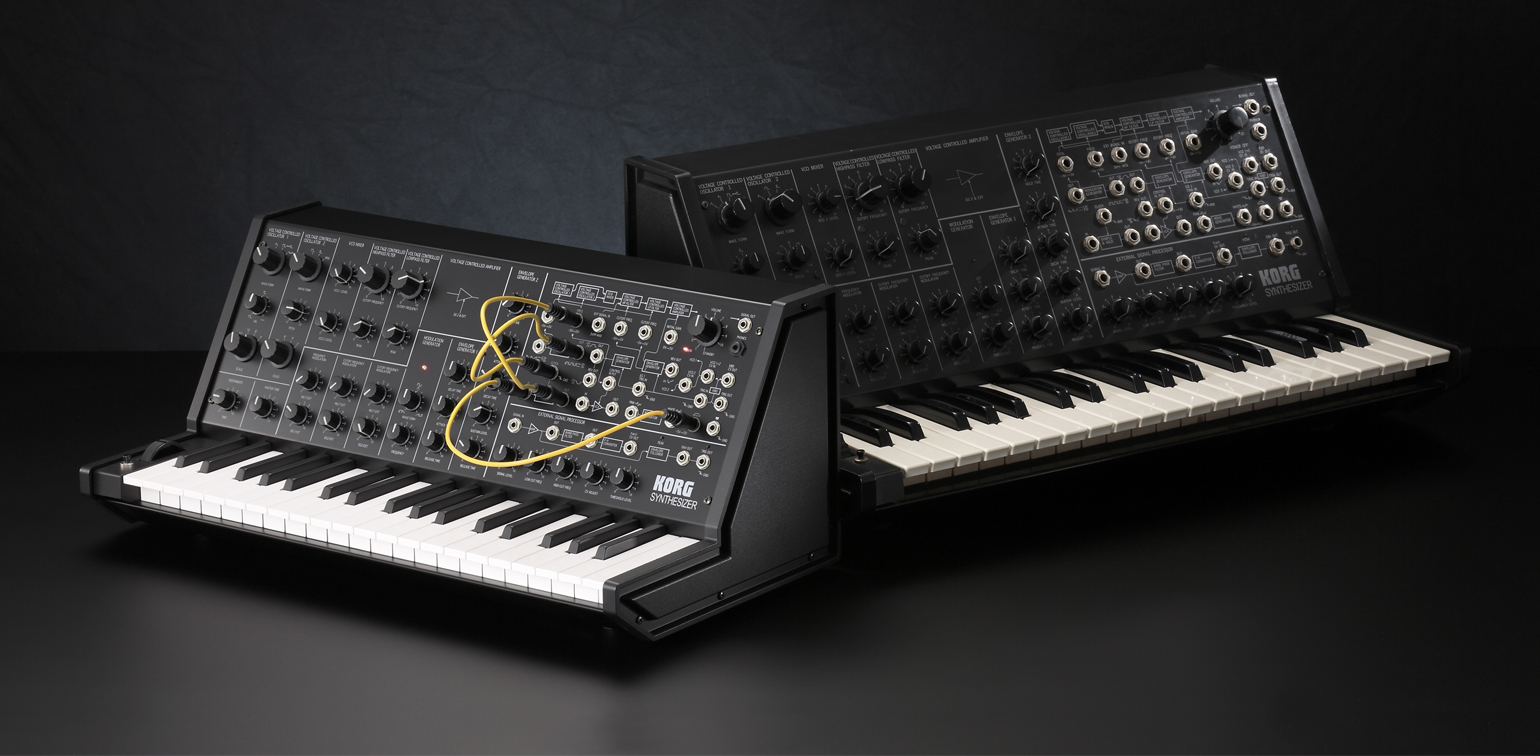
Today, the sounds of the MS-20 have been reborn in hardware, as the MS-20 Mini. The same engineers who developed the original MS-20 have perfectly reproduced its circuitry and fit into a body that’s been shrunk to 86% of the original size, yet retains the distinctive look of the original.
The MS-20 mini will amaze you with its absolutely authentic analog synth sound.
Comments from the developers
Fifty years have passed since Korg was founded, and we have once again put our hand to an analog synthesizer. We took particular care to deliver smooth parameter adjustments, which are a distinctive feature of analog synthesizers. We also took special care to completely reproduce the original specifications of the MS-20. The analog circuits we designed 35 years ago still deliver the same unbeatable, powerful sound, from the ultra-low to the ultra-high range.
Read the full interview with the original developers here!
Highlights:
- Overseen by the engineers of the original MS-20, a complete replication of the original analog circuitry
- 2VCO / 2VCA / 2VCF / 2EG / 1LFO structure
- Self-oscillating high-pass/low-pass filters with distinctive distortion
- External signal processor (ESP)
- Extremely flexible patching system
- Miniature MS-20 that's 86% of the original size
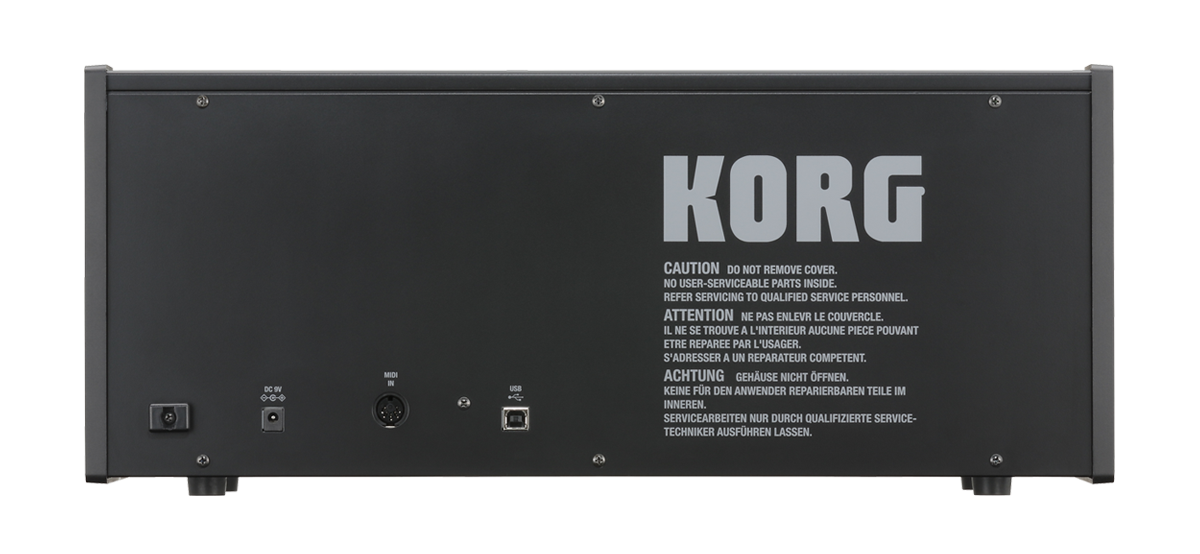
- MIDI IN and USB connector
- Replicates every detail of the original, down to the package binding and the included manual
The MS-20 mini painstakingly replicates the original MS-20. A development team led by the original engineers themselves worked to recreate the original circuitry, and when it was necessary to substitute a part, these engineers made the decisions based on careful listening, in order to reproduce the original sound faithfully.
In fact, the sound of the MS-20 mini has a somewhat bright and extreme quality to it because its sound is that of an original MS-20 in mint condition at the time it went on sale, before any of the components aged.
2VCO / 2VCF / 2VCA / 2EG / 1LFO structure
The MS-20 mini reproduces the distinctive synthesis of the MS-20; two oscillators with ring modulation, and envelope generators with hold and delay. The VCA maintains the basic design of the original, but it’s been modified to produce less noise than the original.
Self-oscillating high-pass/low-pass filters with distinctive distortion
One of the greatest characteristics of the MS-20 was its powerful filters, which provided resonance on both the high-pass and the low-pass. Maximizing the resonance would cause the filter to self-oscillate like an oscillator, producing a distinctive and dramatic tonal change that was acclaimed as inimitable, and was later used on the monotron and monotribe. The filter circuit was changed mid-way through the production lifecycle of the MS-20; the MS-20 mini uses the earlier filter, which was felt to be superior due to its more radical sound.
External signal processor (ESP) for processing an external signal
The ESP carries on the experimental spirit of MS-20; it allows you to use the pitch or volume of an external audio source to control the synthesizer. For example you can input an electric guitar and use the MS-20 mini as a guitar synthesizer, or input a mic and use it as a vocal synthesizer.
Extremely flexible patching system
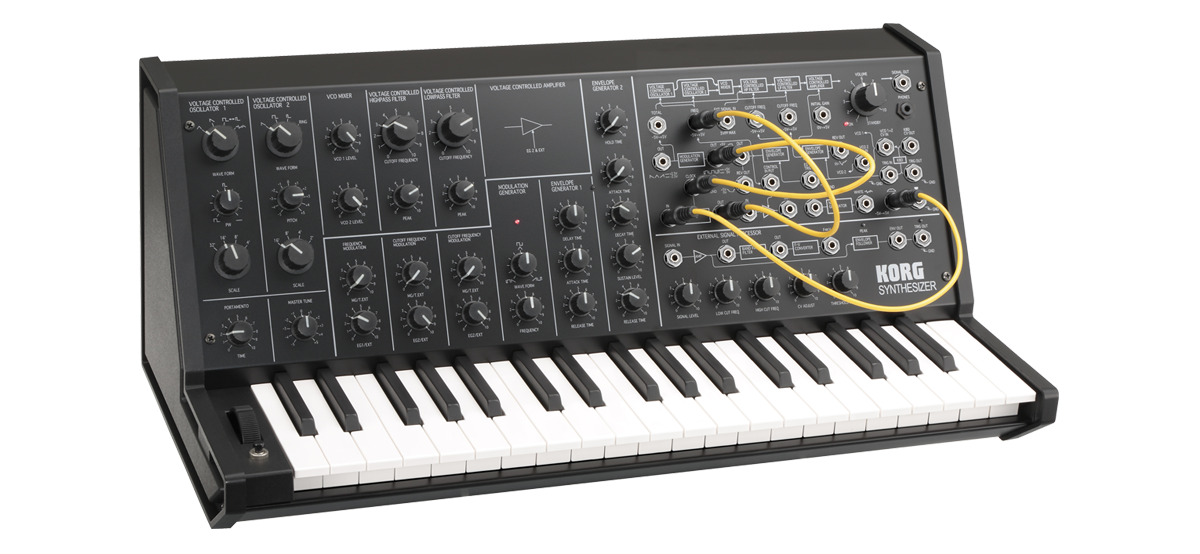
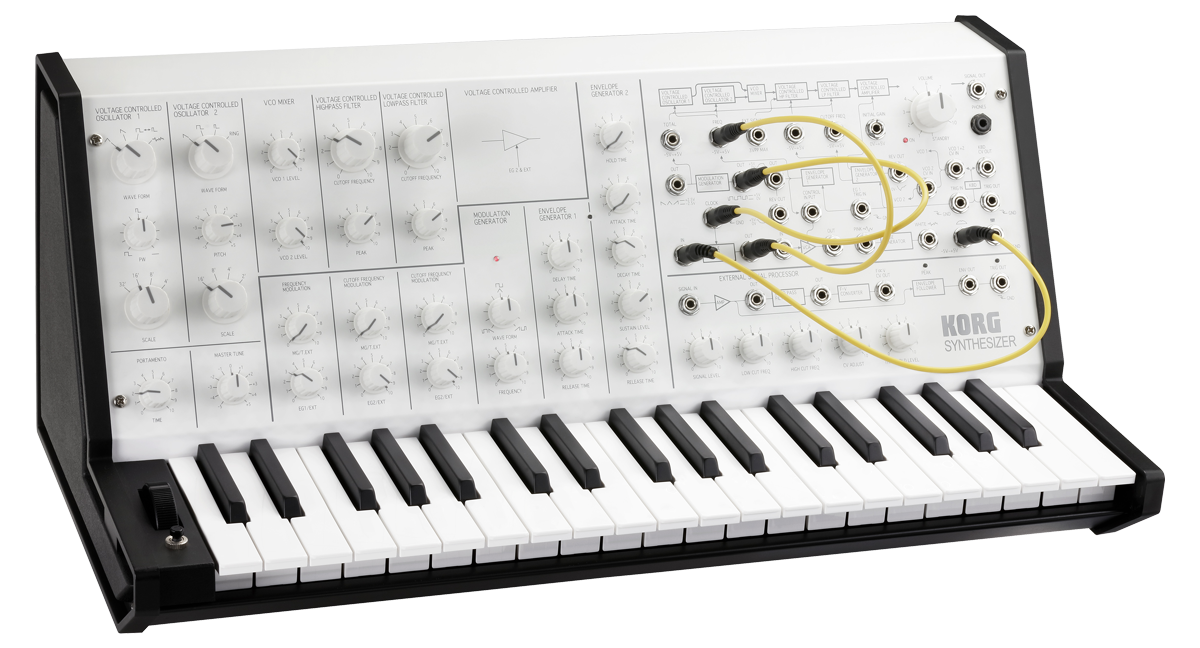
The patching system provided to the right of the panel lets you create complex sounds by plugging-in cables to change the connections between the various units. The possibilities are limited only by the user's imagination; different combinations of the modulation input/output and trigger, sample and hold, and noise generator can produce an incredible variety of sounds. By patching according to the MS-20 flow chart that’s printed on the panel, even the beginner can start taking advantage of these possibilities right away.
MS-20’s design concept started by borrowing from the vertical layout found on larger and more expensive modular synths of its time, and then creating a more portable, inexpensive, and eaier to use version.
To make it even more approachable, the MS-20 mini has been shrunk to 86% of the size of the original MS-20. In spite of its smaller size, meticulous care has been taken to accurately reproduce the knob design and the printing. The patch cables have been changed from 1/4" phone plugs to mini-plugs, and the newly-designed keyboard is also 86% of the original size.
Replicates every details of the original
Our effort to remain faithful to the original is not limited to the unit itself. Even the package that contains the unit replicates the original as far as possible. Also included are the original MS-20 owner's manual and settings chart, explaining how to create sounds. Now you can experience the excitement of the MS20, just like it was during its original release in 1978.
The MS-20 mini provides a MIDI IN jack for receiving note messages, and a USB-MIDI connector that can transmit and receive note messages. You can even connect the MS20 mini to your computer and play it from a sequencer.

Interview with the developers of the "MS-20 mini"
*Mr. Fumio Mieda / KORG INC. Auditor and original engineer on MS-20
*Mr. Hiroaki Nishijima / KORG INC. Chief engineer

Tell us about the concept and development process - along with any interesting encounters you had - during your revival of the original MS-20.
Since the monotron and monotribe allowed us to give users of all ages and levels of musical experience the unique enjoyment of creating sounds with an analog synthesizer, we felt that our next step should be to provide a full-fledged analog synthesizer. The MS-20 is what immediately came to mind. The development of software instruments such as the iMS-20 had given us experience in how to convey the basic design and specifications of the MS series, and we had also heard requests for analog sound modules in the Korg Legacy Collection, so it was a clear and natural decision that we should start the development process.
Developing the MS-20 mini brought to mind numerous memories from when we first developed the MS-20 thirty-five years ago. One particular memory was of our difficulties in deciding how to select transistors. Another interesting memory was when Gotthold Meyer from our German distributer (MUSIK MEYER Corporation) told us that the MS-20 could also be used as educational equipment for teaching science, and that we made an ultra-large MS-20 the size of a blackboard.
How is the MS-20 mini superior to the original MS-20?
We've added MIDI input and a USB port that were not available on the original MS-20, allowing the new model to be smoothly integrated into modern music production environments. Another advantage is that that it's slightly smaller than the original MS-20, saving space. In particular, the newly compact body is something you'll appreciate once you've used it.

Why did you decide on a body size that was 86% of the original MS-20?
We have great respect for the original MS-20, so we felt that it would be devaluing to make the new model exactly the same size as the original. That's why the size is different than the original. We also felt that it looked good in a slightly smaller size.
What gave you the most trouble when designing the MS-20 mini?
As with the original MS-20, there was much deliberation in deciding on the transistors. That's because the performance of an analog synthesizer is greatly affected by things that don't appear on the spec sheet, such as the pairing characteristics of the transistors, and their response and consistency in the micro-current domain.
Earlier and later models of the original MS-20 used different filters. Which filter did you select for the MS-20 mini?
The MS-20 uses the KORG35 circuit that was on the earlier version of MS-20. Preferences vary between users, but we felt that the earlier version of the filter created a sound that had a more distinctive presence, and thus it was the appropriate choice for this reincarnation.
Do you have plans to release circuit diagrams to users so that they can modify the MS-20 to support Hard Sync or Filter-FM, as you did for the monotribe?
As we did for the monotron and monotribe circuit diagrams, we will consider this if there is user demand. However, the MS-20 mini is more complex than the monotron and monotribe, so it will be more difficult to modify.

Can the MS-20 mini receive MIDI control data and respond to it?
Using coarse-resolution (128-step) MIDI data to control an analog synthesizer such as the MS-20 mini will not give you the smooth, un-stepped parameter changes that are characteristic of analog synthesizers, so from the design stage we made the decision to limit MIDI support to note data. This means that if you connect the MS-20 mini's MIDI input to the MIDI output of your keyboard or DAW, it will receive keyboard note data and produce sound in response. As developers, we want you to experience the unique enjoyment of analog synthesizers, so instead of using the parameters of the MS-20 mini via MIDI, we'd like you to use the instrument hands on in real-time and enjoy how the sound changes dynamically.
Do you have plans for reviving other MS series models in the future, such as the SQ-10 or the MS-50?
We want to give people who have never actually touched an analog synthesizer the chance of experiencing how much fun it can be. Just how necessary such a device would be in the present day is something that we'll decide after seeing the response from MS-20 mini users.
Finally, what do the two of you think is the greatest attraction to the MS-20 mini?
Very simply, it's a way to understand the origin of the synthesizer. As the developers, our wish is that the MS-20 mini will let you understand the enjoyment of creating your own sounds from scratch, rather than simply using ready-made sounds. Set it on your desk as your “go-to instrument”!
Specifications
< Control Section >
Keyboard:
C - C 37-notes (3 octaves), mini keyboard designed specifically for the MS-20 mini
Voltage Controlled Oscillator 1 (VCO 1):
Scale (32', 16', 8', 4') (6 octaves, +cent, -cent)
Wave form (Triangle, Sawtooth, PW-Square, White Noise) (4 modes)
Pulse width adjust 1:1 - 1:infinity
Voltage Controlled Oscillator 2 (VCO 2):
Scale (16', 8', 4', 2') (6 octaves, +cent, -cent)
Wave form (Sawtooth, Square, Pulse, Ring modulator) (4 modes)
Pitch (± 1 octave)
VCO Master control: Master tune (± 100cent):
Portamento (max. 10sec)
Frequency modulation intensity by MG/T.EXT (-5V - +5V)
Frequency modulation intensity by EG1/EXT (-5V - 0V)
VCO Mixer:
Voltage Controlled High Pass Filter (VCF HPF):
Cutoff frequency (50Hz - 15,000Hz)
Peak (flat - self OSC)
Cutoff frequency modulation intensity by MG/T.EXT (-5V - +5V)
Cutoff frequency modulation intensity by EG2/EXT (-5V - +5V)
Voltage Controlled Low Pass Filter (VCF LPF):
Cutoff frequency (50Hz - 15,000Hz)
Peak (flat - self OSC)
Cutoff frequency modulation intensity by MG/T.EXT (-5V - +5V)
Cutoff frequency modulation intensity by EG2/EXT (-5V - +5V)
Envelope Generator 1:
Delay time (10sec)
Attack time (10sec)
Release time (10sec)
Envelope Generator 2:
Hold time (20sec)
Attack time (10sec)
Decay time (10sec)
Sustain level (0V - 5V)
Release time (10sec)
Modulation Generator (LFO):
Wave form (Positive Sawtooth - Triangle - Negative Sawtooth, Wide Pulse - Square - Narrow Pulse)
Frequency (0.1Hz - 20Hz)
Manual controller:
Control wheel (center click)
Momentary switch -->GND
Power switch and Volume:
Indicator:
LED (KBD trigger, Modulation Generator rate, Power ON )
< External Signal Processor >
Control section:
Input signal level
Low cut frequency (50Hz - 2,500Hz)
High cut frequency (100Hz - 5,000Hz)
CV adjust
Threshold level
Input and Output:
Signal In
Amplifier Out
Band pass filter Out
CV Out (0 - +8.4V)
ENV Out (0 - +5V)
Trig Out (+5V-->GND)
Indicator (LED):
Peak indicator
Trigger indicator
< Patch Panel >
Keyboard:
Keyboard control voltage output (Exponential) (0 - +8V)
Keyboard trigger output (+5V-->GND)
VCO-1 + VCO-2 control voltage input (Linear response)(0 - +8V)
VCO-2 control voltage input (Linear response) (0 - +8V)
VCO:
VCO-1 + VCO-2 external frequency control input (OCT/V) (-5V - +5V)
VCF:
External signal input (3Vp-p max.)
External High pass filter cutoff frequency control input (2OCT/V) (-5V - +5V)
External Low pass filter cutoff frequency control input (2OCT/V) (-5V - +5V)
VCO + VCF:
Total external modulation input (T.EXT)(-5V - +5V)
VCA:
External initial gain control input (0 - +5V)
EG:
EG 1 envelope signal normal output (-5V - 0V)
EG 1 envelope signal reverse output (+5V - 0V)
EG 1 + EG 2 trigger input (-->GND)
EG 1 trigger input (-->GND)
EG 2 envelope signal reverse output (+5V - 0V)
MG:
Triangle output (Positive Sawtooth - Triangle - Negative Sawtooth) (5Vp-p)
Rectangle output (Wide Pulse - Square - Narrow Pulse)(0 - +5V)
Noise Generator:
Pink noise output (5Vp-p)
White noise output (5Vp-p)
Sample and Hold:
Clock trigger input (-->GND)
Sample signal input (5Vp-p max.)
S/H output (5Vp-p max.)
Modulation VCA:
Control voltage input (0 - +5V)
Signal input (-5V - +5V)
Signal output (-5V - +5V)
Manual controller:
Control wheel output (-5V<--0V-->+5V)
Momentary switch output (-->GND)
Signal out:
Signal output (mono 1/8" mini phone jack, 2Vp-p output impedance 3.5k ?)
Head phones:
Head phones output (Stereo 1/8" mini phone jack, 33 ? 48mW)
USB:
Type B, USB-MIDI Input/Output
* Only note messages (velocity is not used) can be transmitted and received.
MIDI:
*Only note messages (velocity is not used) can be transmitted and received.
Power Consumption:
Power Supply:
Dimensions (W x D x H): a
493 ×257 ×208 mm / 19.41 x 10.12 x 8.19 inches
Weight:
Accessories:
AC adaptor (9V/1.7A), Patch Cord x 10
*Specifications and appearance are subject to change without notice for improvement.
News
WINTER NAMM, ANAHEIM, CALIFORNIA, January
24th, 2013 - Korg's MS-20 monophonic synthesizer, first introduced in 1978,
is still coveted to this day for its thick, robust sound, powerful, iconic
analog filter, and versatile patching options. It has now been reborn as the
new MS-20 mini. The same
engineers who developed the original MS-20 have perfectly reproduced it in a
body that's been shrunk to 86% of the original size, yet retains the distinctive
look of the original.
The MS-20 Mini offers the same distinctive
synthesis that made the original MS-20 popular: two oscillators with ring
modulation, and envelope generators with delay and hold. The VCA (Voltage
Controlled Amp) maintains the original basic design, but it's been modified to
produce less noise. Particular attention has also been paid to delivering smooth
parameter adjustments, which are a distinctive feature of analog synthesizers.
Special care was also taken to completely reproduce the original specifications
of the MS-20, to deliver the same powerful sound, from deep, growling basses to
crisp, rounded leads.
One of the most well-known - and still most sought
after - characteristics of the original MS-20 was its powerful filters, which
provided both high-pass and low-pass with peak/resonance. Maximizing the
peak/resonance would cause the filter to self-oscillate; producing a distinctive
and dramatic tonal change that was acclaimed as inimitable, and was used many
years later on Korg's monotron and monotribe. The filter circuit was changed
mid-way through the production lifecycle of the MS-20; the MS-20 mini uses the
earlier filter, which was felt to be superior due to its more radical
sound.
The ESP (External Signal Processor) functionality carries on the
experimental spirit of MS-20, allowing users to utilize the pitch or volume of
an external audio source to control the synthesizer. For example, an electric
guitar can be used as an input signal, and the MS-20 mini can be used as a
guitar synthesizer, or the mic input can allow it to be used it as a vocal
synthesizer.
The patching system enables the creation of complex sounds
by allowing the rerouting of both modulation and audio (both the internal
oscillators and external audio). Different combinations of the modulation
input/output and trigger, sample and hold, and noise generator can produce an
incredible variety of sounds. By patching according to the MS-20 flow chart
printed on the panel, musicians of all levels can take advantage of these
possibilities right away.
To make it even more approachable, the MS-20
mini has been shrunk to 86% of the size of the original, with meticulous care
taken to accurately reproduce the knob design and the printing. The patch cables
have been changed from 1/4" phone plugs to mini-plugs, and the newly-designed
keyboard is 86% of the original size as well.
The MS-20 mini is equipped
with a MIDI IN jack for receiving note messages, and a USB-MIDI connector that
can transmit and receive note messages. Users can also connect the MS20 mini to
a computer and play it from an external sequencer.
For added
authenticity, the MS-20 mini packaging replicates much of the original. Also
included are the original MS-20 owner's manual and settings chart.
The
Korg MS-20 Mini will be available May 2013 for a U.S. Street price of $599.00
Additional product information is available at Korg.com.
|